Binance Fee Discounts: BNB, VIP Tier and Referral
Paying fees in BNB, moving up a tier and using a referral code are independent layers that stack. Where to enable each one and how to confirm it applied.
The fee in the published table is a starting point, not necessarily what you pay. Discounts apply on top of it, in independent layers. People who enable all three pay noticeably less than people who enable none — and most people enable none simply because nobody told them the layers exist.
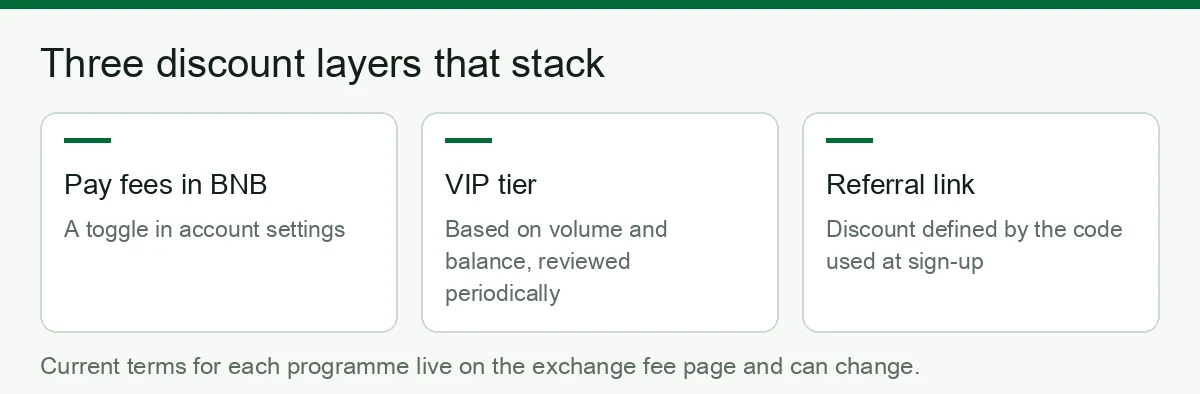
Layer 1 — pay fees in BNB
BNB is the platform's own token, and it has one practical function here: with the option switched on, your trading fees are charged in BNB at a discount to the standard amount. It is a toggle in account settings, not a product you sign up for.
What to know before enabling it:
- You need to hold some BNB. With no balance, charging falls back to the default.
- BNB is a volatile asset. Holding a balance to pay fees means holding exposure to it — size it deliberately.
- The discount follows the programme's current terms, which the exchange can revise.
What the token is and why it exists is covered in what is BNB; small leftovers can be turned into BNB via converting dust.
Layer 2 — volume tier (VIP)
The exchange sorts users into tiers based on volume traded over a recent window plus balance held. Higher tiers get better rates on both sides, maker and taker.
Be realistic here: for someone investing a few hundred or a few thousand a month, the tier barely moves. Do not force volume to climb tiers — trading more to pay less per trade is a losing swap. This layer matters for people who already trade heavily; it is not a target to chase.
Layer 3 — referral code
The code used at sign-up sets a discount on trading fees, under the programme's current terms. The critical detail: it is normally applied when the account is created and cannot be changed afterwards. People with older accounts and no code rarely get to change that.
If you do not have an account yet, this is the one discount that depends on a step which only happens once.
How to verify the discounts are applied
Do not trust settings; trust the statement:
- Place a small spot order.
- Open Orders → Trade history.
- Look at the fee line: the amount, and which asset it was charged in.
If it was charged in BNB, layer 1 is active. Comparing the effective percentage against the standard table shows the combined effect of the other layers. It is a two-minute test worth more than any assumption.
The discount that is not a discount: change the habit
Before chasing layers, fix the basics — they usually pay more:
- Limit orders instead of market orders change the tier you are charged at (maker vs taker).
- Fewer intermediate conversions means fewer charges.
- Fewer, larger withdrawals dilute the fixed network fee (withdrawal fees).
Bottom line
Three independent layers: BNB, tier and referral. The first two are in your hands today; the third only exists at account creation. And none of them replaces the habit of trading with limit orders and short routes. The full cost map is in Binance fees in Brazil.
Affiliate disclosure: this article contains referral links. If you sign up to Binance (code BN6691) through our links, you get a 20% trading-fee discount (under the programme's current terms) and this site earns an affiliate commission at no extra cost to you.
Risk warning: crypto assets are volatile and high risk; you can lose all of your capital. This content is educational and informational only and is not financial, legal or tax advice. Do your own research before trading.
Regional notice: this site is aimed at readers in Brazil. It is not directed at residents of mainland China, the United States, the United Kingdom or Canada. Check and follow the rules in force where you live.
Related
Binance Convert Spread: How to Measure the Real Cost
Binance Convert says "no fee" — the cost lives in the quote. How to measure the embedded spread in 30 seconds, with a step-by-step calculation.
Staking on Binance: How It Works and What It Pays
Staking rewards come from the network, not from an exchange promise. How Binance staking works behind the scenes, the real risks, and how to test small.
Binance P2P vs Spot: Where Is the Price Better?
P2P shows zero fees, spot charges 0.1% — but the ad's premium decides the real price. A 3-minute method to compare the effective cost of both routes.